Key takeaways
- Peec AI has transparent, self-serve pricing starting at €89/month with a free trial. Meridian requires a demo and uses custom pricing, which almost always means higher cost.
- Both tools track brand visibility, sentiment, and position across AI search engines like ChatGPT, Perplexity, and Gemini -- but Meridian leans into a managed/agency model while Peec AI is built for in-house marketing teams.
- Meridian's pitch is "expert-led, agent-powered" -- meaning they combine software with human execution. Peec AI is pure software: you get the data, you act on it.
- Peec AI supports multi-language and multi-country tracking from the Starter plan (3 countries, expanding to 10 on Professional). Meridian shows multi-language demos but doesn't publish specifics.
- Neither tool includes built-in content generation or answer gap analysis -- both are monitoring-first platforms. If you need to actually fix your AI visibility, not just measure it, you'll need something more.
- Peec AI is trusted by 2,000+ marketing teams. Meridian is newer and positions itself at the premium end of the market.
Overview
Meridian
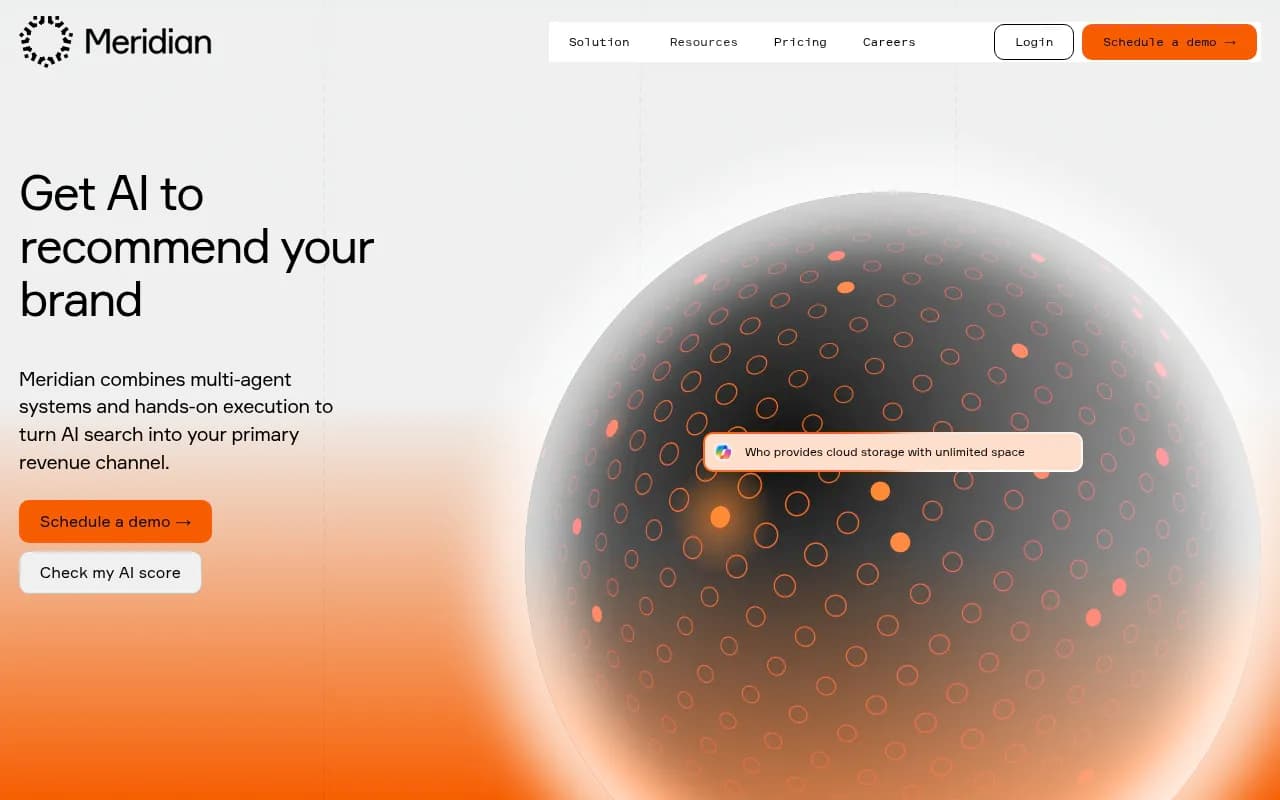
Meridian's core pitch is that AI search should be your "primary revenue channel" -- and they want to help you get there through a combination of software and hands-on execution. The platform monitors brand visibility across ChatGPT, Perplexity, Gemini, Google AI, Meta AI, Grok, DeepSeek, and Copilot, tracking metrics like visibility score, sentiment, and position. What makes Meridian different from a pure SaaS tool is the "agent-powered" layer: they pair the monitoring data with expert-led growth systems, which sounds closer to a managed service than a self-serve dashboard.
The catch is that there's no public pricing. You schedule a demo, they assess your situation, and you get a custom quote. That's fine if you're a larger brand or agency with budget to match, but it's a real barrier if you just want to try something out.
Peec AI
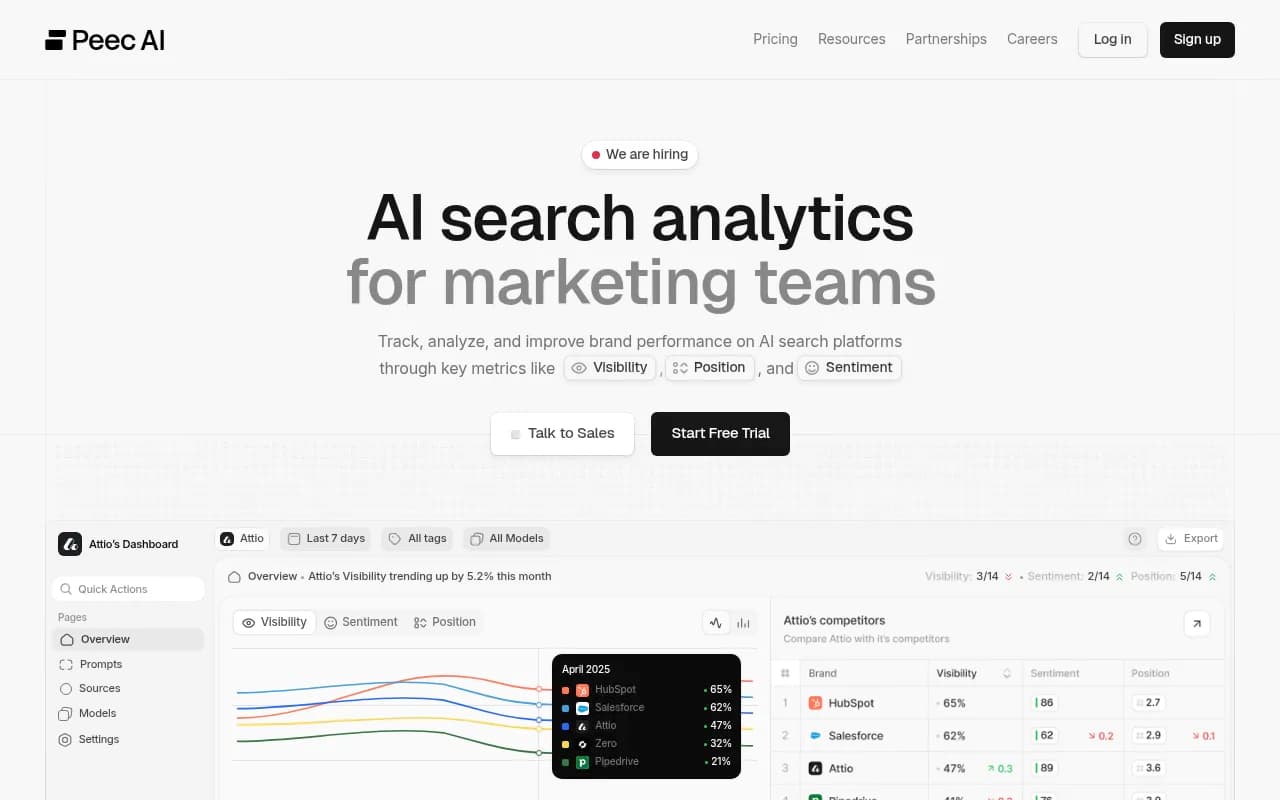
Peec AI is a cleaner, more straightforward proposition: an AI search analytics platform for marketing teams. You track how your brand appears in AI search results, benchmark against competitors, and get visibility, position, and sentiment scores across models. The interface looks polished, the pricing is public, and you can start a free trial without talking to anyone.
The platform is trusted by 2,000+ marketing teams and agencies, which gives it some credibility as a proven tool rather than an early-stage experiment. Its multi-language and multi-country support is a genuine differentiator at the lower price tiers -- useful for any brand operating across markets.
Side-by-side comparison
| Feature | Meridian | Peec AI |
|---|---|---|
| Pricing model | Custom (demo required) | Transparent, from €89/mo |
| Free trial | No (demo only) | Yes |
| Starting price | Unknown | €89/month |
| AI models tracked | ChatGPT, Perplexity, Gemini, Claude, Google AI, Meta AI, Grok, DeepSeek, Copilot | ChatGPT, Perplexity, Gemini + all models on Professional |
| Visibility tracking | Yes | Yes |
| Sentiment analysis | Yes | Yes |
| Position tracking | Yes | Yes |
| Competitor benchmarking | Yes | Yes |
| Multi-language support | Yes (shown in demos) | Yes (from Starter plan) |
| Multi-country tracking | Yes | 3 countries (Starter), 10 (Professional) |
| Content generation | No | No |
| Answer gap analysis | No | No |
| AI crawler logs | No | No |
| Managed/expert services | Yes (core differentiator) | No |
| Self-serve dashboard | Yes | Yes |
| Target audience | Enterprises, agencies | Marketing teams, SMBs |
Head-to-head feature deep-dive
Pricing and accessibility
This is where the two tools diverge most sharply. Peec AI publishes its pricing clearly:
| Plan | Price | Prompts | Countries |
|---|---|---|---|
| Starter | €89/month | 25 | 3 |
| Professional | €199/month | 75 | 10 |
| Business | Custom | Custom | Custom |
Meridian shows nothing. No pricing page, no ballpark, just a "Schedule a demo" button. That's a deliberate choice -- it signals they're selling to buyers who have budget conversations with sales teams, not marketers who want to sign up with a credit card.
For most marketing teams evaluating tools in 2026, the lack of transparent pricing is a friction point. You have to invest time in a sales process before you know if the tool is even in your budget. Peec AI removes that friction entirely with a free trial you can start right now.
Verdict: Peec AI wins on accessibility. Meridian may be worth the sales conversation if you're a larger organization, but for most teams, Peec AI's model is just easier to work with.
AI model coverage
Both platforms cover the models that matter most: ChatGPT, Perplexity, Gemini, Claude, and Google AI. Meridian's website also prominently shows Meta AI, Grok, DeepSeek, and Copilot logos, suggesting broad coverage. Peec AI covers "all models" on its Professional plan (€199/month), but the Starter plan may be more limited.
Neither platform publishes a definitive list of every model and every tracking capability per model, which makes a precise comparison difficult. Based on what's publicly visible, Meridian appears to have slightly broader model coverage built into its base offering, but Peec AI's Professional plan closes that gap.
Verdict: Roughly even at the Professional/full-feature tier. Meridian may have a slight edge on breadth out of the box.
Core monitoring features
Both tools track the same three core metrics: visibility (how often your brand appears), position (where you rank in AI responses), and sentiment (how AI models describe your brand). Both offer competitor benchmarking so you can see how you stack up against rivals in the same category.
Meridian's demo screenshots show category-level tracking -- you can monitor an entire product category, not just your own brand mentions. That's useful for understanding the competitive landscape in your space. Peec AI's interface shows similar competitive benchmarking with percentage-based visibility scores across competitors.
One thing worth noting: Peec AI lets you add your own custom prompts and organize them with tags, which gives you control over what you're tracking. This is standard for the category but worth confirming Meridian offers the same flexibility.
Verdict: Comparable on core monitoring. Meridian's category-level tracking is a nice touch; Peec AI's custom prompt organization is practical for day-to-day use.
Multi-language and multi-region support
Peec AI makes multi-language and multi-country tracking a clear selling point. The Starter plan covers 3 countries, Professional covers 10, and the Business plan is custom. This is genuinely useful for brands operating across markets -- you can track how AI models in Japan respond to queries about your brand differently from how models in Germany do.
Meridian's demo shows a Japanese-language query ("東京でホテルを予約するにはどこ?") being tracked, which confirms multi-language capability. But without published specs, it's hard to know how many languages or regions are supported at what tier.
Verdict: Peec AI wins on transparency here. You know exactly what you're getting at each price point. Meridian likely has the capability but doesn't tell you the details upfront.
Managed services vs. self-serve
This is the most fundamental difference between the two tools, and it comes down to what kind of buyer you are.
Meridian's "expert-led, agent-powered" model means you're not just buying software -- you're buying a team that helps you execute. That's valuable if you don't have internal resources to act on the data, or if you want a partner who takes ownership of results. It's also why custom pricing makes sense: the cost includes human time, not just platform access.
Peec AI is pure software. You get the dashboard, the data, and the recommendations. What you do with it is up to you. That's fine for teams with the capacity to act on insights, but if your team is stretched thin, the data can sit unused.
Verdict: Depends entirely on your situation. If you want a partner to execute, Meridian's model is appealing. If you have an in-house team that can act on data, Peec AI's self-serve approach is more cost-effective.
Content optimization and gap analysis
Neither tool helps you create content to improve your AI visibility. Both are monitoring platforms -- they show you where you stand, but they don't help you close the gaps. This is a real limitation if your goal is to actually improve your AI search presence rather than just measure it.
If that's a priority, it's worth knowing that Promptwatch takes a different approach: it combines visibility tracking with answer gap analysis and a built-in AI writing agent that generates content specifically engineered to get cited by AI models.

Verdict: Neither Meridian nor Peec AI wins here -- it's a gap both tools share.
Pricing comparison
| Plan | Meridian | Peec AI |
|---|---|---|
| Free trial | No | Yes |
| Entry-level | Custom (demo required) | €89/month (25 prompts, 3 countries) |
| Mid-tier | Custom | €199/month (75 prompts, 10 countries, all models) |
| Business/Enterprise | Custom | Custom |
| Annual discount | Unknown | Likely (not published) |
Pros and cons
Meridian
Pros:
- Managed service model means you get expert execution, not just data
- Broad AI model coverage including Meta AI, Grok, DeepSeek
- Category-level tracking gives a wider competitive view
- Multi-language capability confirmed in demos
- Suited to brands that want a partner, not just a tool
Cons:
- No public pricing -- requires a sales conversation before you know the cost
- No free trial to evaluate before committing
- Newer platform with less publicly available social proof
- No content generation or gap analysis
- Managed service model may be overkill (and overpriced) for teams that can self-serve
Peec AI
Pros:
- Transparent pricing starting at €89/month
- Free trial available -- no sales call required
- 2,000+ marketing teams using it (established user base)
- Multi-language and multi-country support from the Starter plan
- Clean, intuitive dashboard with custom prompt organization
- Good competitor benchmarking at accessible price points
Cons:
- No managed services or expert execution layer
- No content generation or answer gap analysis
- Starter plan limited to 25 prompts and 3 countries
- All-model coverage requires the Professional plan (€199/month)
- No AI crawler logs or traffic attribution
Who should pick which tool
Choose Meridian if:
- You're a larger brand or agency with budget for a premium, managed-service engagement
- You want a partner who takes ownership of execution, not just a dashboard to log into
- You're tracking across a wide range of AI models from day one
- You don't have internal capacity to act on monitoring data yourself
Choose Peec AI if:
- You're a marketing team that wants to self-serve and move fast
- You want to try before you buy -- the free trial is a real advantage
- You're operating across multiple countries and languages and need that from the start
- Budget matters and you want to know what you're paying before talking to sales
- You're an SMB or mid-market brand that doesn't need a managed service layer
Consider neither if:
- Your primary goal is to improve AI visibility, not just measure it -- both tools are monitoring-first, and you'll need a platform with content gap analysis and optimization capabilities to actually move the needle
Final verdict
Peec AI is the more practical choice for most marketing teams in 2026. The transparent pricing, free trial, and clean self-serve experience remove the friction that Meridian's demo-required model introduces. For teams that want to start tracking AI visibility quickly without a sales process, Peec AI is the obvious starting point.
Meridian makes sense if you're looking for something closer to a managed service -- a partner who combines the monitoring data with hands-on execution. That's a genuinely different value proposition, but it comes at a cost (literally, since you won't know the price until you talk to them).
The honest caveat for both: if you want to actually improve your AI search visibility rather than just track it, you'll eventually hit the ceiling of what either platform can do. Monitoring tells you where you stand. Closing the gap requires content strategy, gap analysis, and optimization -- capabilities neither tool currently offers.